I have to admit that I might have really overdone it a bit with being completely organic, such as the hybrid tomato seeds and such. But I just don't want my garden to be non organic at all.
One of the most controversial subjects about this topic was when we were told that it would be a good idea to put in some soil additives. They are those little round pill things that you sprinkle around your bed. Being the paranoid person I am, I wanted to see if these additives were truly organic. The first pill was phosphate, which my dad says comes from a rock so this was organic. The phosphate is used to put phosphorous, a fertilizer, in the ground. The second additive was sulfur. This too is a mineral so organic and is used to put helpful organisms in the soil since they eat the sulfur. Finally, there was cow urea. This was a problem. Reading The Omnivore's Dilemma I know that conventional cows are treated quite badly and are stuffed full of unhealthy antibiotics. So I was wondering does the urea come from organic cows or conventional cows. I asked one of the starters of the community garden who is a seasoned gardener, and she replied, "Unless the organic farmers followed the cow around the pasture until it gave it's urea I'd say this was conventional." This made me uneasy. My dad reasoned that the antibiotics probably don't come into the cow urea, but I wasn't too sure. We each did our research for quite a bit and we both came to the conclusion, we would pass on the urea. My reason was that cow urine actually does have traces of antibiotics in it. That would make my garden non organic. My dad's reason was partly that, being a vegetarian, he didn't feel comfortable using an animal product. His main reason however was that it seems that even though the urea has lots of nitrates (fertilizer) and balances the pH (acidity and alkalinity) of the dirt, it kills the small organisms that sulfur brings. So, we decided to skip it. I don't know if my garden was affected because of my lack of cooperation for the urea, but I do know that it's a little more organic, because of it.
Wednesday, September 26, 2012

Monday, September 3, 2012
My Plan
My plan for my garden was a very very hard thing to put together. I never really thought about how different each vegetable was. Vegetables grow at all different times. They like and dislike climates, and take different amounts of time to grow. Some keep producing, while some need to be planted in succession. While I juggled with all these aspects I had to consider how deep each seed should go. Also how high they had to grow. You couldn't have a plant block sunlight from another. Also how many plants for each square foot and some spread, so the book had an idea about vertical gardening. It's where you take a vine plant like a pumpkin or a cucumber and trail it to climb up something like a vertical net. That way it doesn't take up so much room. (We wanted to do this but we didn't really complete it for all the vegetables. We did get a cucumber to crawl up this catchers net we erected. Instead we let the other vine plants trail out into our plant walking aisle. This turned out fine except now it is barely possible to walk in some of our aisles at all.)
Anyway back to my plan. At this time you know I was in trouble. Every time I thought I understood this a new problem or exception would come up. How in the world would I graph this? My dad had an idea. He made a calender from March to October in weekly intervals. After that I caught on to the idea. I put my 16 vegetables vertically while my dad's calendar weeks were horizontally. I started with looking at my seed packets where they said how long it took and roughly divided by 7. Then I put how long it took to germinate. (I thought it was one week. Big mistake as I'm going to find out.) Then I put the indoor starting time. Of course some can't be indoors like radishes, so they were just put in the ground at the appropriate time. I followed this with putting all plants outside in the ground, and how long till harvest. Some had to be replanted while others kept creating vegetables. Then it was brought to my attention the fact that the vegetables liked and disliked certain seasons. So after finding the seasons I created dead seasons, when the plant wouldn't be growing. All of this was based off the idea that April 23rd was the end of frost and October 10th was the start of frost. I then color coded and made a key for the calender. I then made a separate spreadsheet about the seed depth, width from other seeds, and the height of the plant. I used this to help plan out my bed. When I first drew it up, I had just tried to make it symmetrical. Once again my dad said I had forgotten something; height. The small plants should be up front, and the big ones behind, so they would all get equal sunlight. Plus the vine plants should be near the edge. I then rewrote it. I realized how much space I had in the bed. (In real life with the plants growing everywhere the space gets cramped.) Anyhow I color coded, labeled, and keyed the bed. In the key there was the abbreviation of the vegetable I was using, how many plants per square feet, how many seeds I needed and how many I needed indoors.
This plan was made using confusing research, modern technology (is Spreadsheet modern), and, yes, a few arguments (how about discussions?), among other painstaking things. But at the end I think I have a clue what to do.
I don't have good pictures of the climbing cucumber plants, the clogged aisles, and my plan, but I will upload it shortly.
Anyway back to my plan. At this time you know I was in trouble. Every time I thought I understood this a new problem or exception would come up. How in the world would I graph this? My dad had an idea. He made a calender from March to October in weekly intervals. After that I caught on to the idea. I put my 16 vegetables vertically while my dad's calendar weeks were horizontally. I started with looking at my seed packets where they said how long it took and roughly divided by 7. Then I put how long it took to germinate. (I thought it was one week. Big mistake as I'm going to find out.) Then I put the indoor starting time. Of course some can't be indoors like radishes, so they were just put in the ground at the appropriate time. I followed this with putting all plants outside in the ground, and how long till harvest. Some had to be replanted while others kept creating vegetables. Then it was brought to my attention the fact that the vegetables liked and disliked certain seasons. So after finding the seasons I created dead seasons, when the plant wouldn't be growing. All of this was based off the idea that April 23rd was the end of frost and October 10th was the start of frost. I then color coded and made a key for the calender. I then made a separate spreadsheet about the seed depth, width from other seeds, and the height of the plant. I used this to help plan out my bed. When I first drew it up, I had just tried to make it symmetrical. Once again my dad said I had forgotten something; height. The small plants should be up front, and the big ones behind, so they would all get equal sunlight. Plus the vine plants should be near the edge. I then rewrote it. I realized how much space I had in the bed. (In real life with the plants growing everywhere the space gets cramped.) Anyhow I color coded, labeled, and keyed the bed. In the key there was the abbreviation of the vegetable I was using, how many plants per square feet, how many seeds I needed and how many I needed indoors.
This plan was made using confusing research, modern technology (is Spreadsheet modern), and, yes, a few arguments (how about discussions?), among other painstaking things. But at the end I think I have a clue what to do.
I don't have good pictures of the climbing cucumber plants, the clogged aisles, and my plan, but I will upload it shortly.
Saturday, September 1, 2012
Coming Up
My school year is about to start so I might not be able to do posts for a couple days. But after that be ready to learn about my garden plan.
The Blomer signing out.
The Blomer signing out.
Monday, August 27, 2012
Making the Raised Beds
Now everyone needed raised beds. Well not everyone. I believe 1 or 2 families just wanted row gardening.

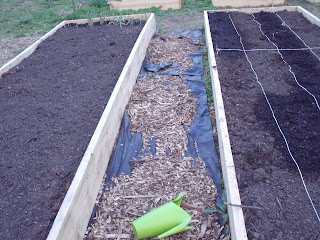 Here is our walkway half finished next to two of our beds. The string you see on the right was the beginning of my square foot plotting. I already planted in this picture.
 Here is part of the community garden with the beds filled.
The majority of people were going to have wooden boards connected in a rectangle. It would be like a box with no top or bottom. I was at the Pennsylvania Association of Environmental Educators with a few classmates but my dad was there. His back was sore for a whole day. He said they had to construct the boxes, carry it down a hill and place it in the spot. And there were 180 of them, 3 for every plot. Each box was 16 feet by 4 feet. That's 64 sq. ft a box. The height was probably a half foot maybe more. Then we had to fill the 3 boxes with dirt. But even before that we had to pull out the weeds. I had chosen the middle bed with a medium amount of weeds. My mom's bed was really weedy so we covered the bottom in a tarp thing. I believe it was bio degradable but I'm not sure. It might not have been. My dad and I didn't have as many weeds so we opted out on this tarp material. Our community garden is right next to the place where all the leaf compost goes, so there are mounds and huge hills full of compost. We used that to fill our beds, about 12 wheelbarrows per bed. This was hard because the mounds were on the other side from our beds, and up a hill. Unlike other plots we filled our boxes almost to the brim. Then we realized that you can make the bed better for a plant by mixing in peat moss and such sandy fluffy material so that the soil isn't so hard for a plant's roots to breach through. It was about 2 bags to cover 1 box. We had to go to the garden twice that day to fill all the beds. In between the 3 beds there were walkways, which we covered with remaining tarp and wood chips. So by the end of the day there were three filled beds with two walkways, and a thin perimeter which made up our plot.

Here is what a bed of ours looked like.
 Here is our walkway half finished next to two of our beds. The string you see on the right was the beginning of my square foot plotting. I already planted in this picture.
 Here is part of the community garden with the beds filled.
Wednesday, August 22, 2012
The Experienced Dad
You might have seen from these past few blogs that my dad has a pretty good idea of what he's talking about with the garden. The reason for that is that when he was a child he lived on the property with the pond. If you remember I said it was rural so one summer I belive he went and worked with the farmer there in exchange for some vegetables to take home. That is how he became so experienced. He still calls himself an amateur which is true when you see some of the other gardeners beds at the community garden. But we're both learning fast
Tuesday, August 14, 2012
Square Foot Gardening
Whenever I pictured gardening, being the amateur I was, I pictured neat rows of plants with a hoe in hand. Okay maybe not the hoe, but I pictured this from
a)the various books like Peter Rabbit that I've read over the years and movies/ T.V shows.
b)From seeing conventional crops. That's different from a community garden because their crops are much bigger and are usually monocultures (1 type of crop). Also they use pesticides and fertilizers which help keep things tidy but in the long run are bad. Well, also in the short run.
Anyway I was picturing this when my dad got a book from the library. All New Square Foot Gardening by Mel Bartholomew.
What is Square Foot Gardening? It is where you take 1 square foot of a bed and fill it with 1 type of vegetable. The number of plants per sq. foot depend on the plant size. For example you could have 16 carrots in 1 square foot, 1 squash in another. The number of plants per square foot could be 0.5,1,2,4,8,9,16. Square Foot Gardening works for all plants: fruits, vegetables, flowers, etc.
The book provides more information on this plus many other facts and tips. The book is definitely something you should consider looking at. Another is What is Wrong with My Vegetable Garden? My family thought we needed this before we even started. Talk about pessimists! The book discussed the various pests and diseases and how to deal with it. It also had growing and regular facts about a lot of the common vegetables.
Anyway getting back to Square Foot Gardening. There were some problems with this planting idea which I will mention in future blogs. The idea is a pretty good one though. It is supposed to be easier and give 5 times the harvest! That is because every part of the bed is used, unlike row gardening where there are walking paths in the rows. Though I was at first reluctant to the idea, my dad persuaded me to try it out. I've decided to do this more or less every year. In Square Foot Gardening you use raised beds: planks constructing a box with no top or bottom, which you then fill with dirt. Most of the people at the community garden used raised beds.
a)the various books like Peter Rabbit that I've read over the years and movies/ T.V shows.
b)From seeing conventional crops. That's different from a community garden because their crops are much bigger and are usually monocultures (1 type of crop). Also they use pesticides and fertilizers which help keep things tidy but in the long run are bad. Well, also in the short run.
Anyway I was picturing this when my dad got a book from the library. All New Square Foot Gardening by Mel Bartholomew.
What is Square Foot Gardening? It is where you take 1 square foot of a bed and fill it with 1 type of vegetable. The number of plants per sq. foot depend on the plant size. For example you could have 16 carrots in 1 square foot, 1 squash in another. The number of plants per square foot could be 0.5,1,2,4,8,9,16. Square Foot Gardening works for all plants: fruits, vegetables, flowers, etc.
The book provides more information on this plus many other facts and tips. The book is definitely something you should consider looking at. Another is What is Wrong with My Vegetable Garden? My family thought we needed this before we even started. Talk about pessimists! The book discussed the various pests and diseases and how to deal with it. It also had growing and regular facts about a lot of the common vegetables.
Anyway getting back to Square Foot Gardening. There were some problems with this planting idea which I will mention in future blogs. The idea is a pretty good one though. It is supposed to be easier and give 5 times the harvest! That is because every part of the bed is used, unlike row gardening where there are walking paths in the rows. Though I was at first reluctant to the idea, my dad persuaded me to try it out. I've decided to do this more or less every year. In Square Foot Gardening you use raised beds: planks constructing a box with no top or bottom, which you then fill with dirt. Most of the people at the community garden used raised beds.
Friday, August 3, 2012
Seeds
Now again I return to my garden. It seems every time I try to continue this story, other stories pop up.
The beginning of my garden experiences was continued in Gentile's a fresh produce store. I've always known that Gentile's had many seeds so I knew I wanted to get my seeds here. You should have seen how many types there were for some vegetables. There were 8 types of beans! Every seed packet was $0.99 even though some were bulging like the peas and beans and others like the oregano and lettuce were so thin that it seemed there was nothing in there until you shook it, where you would be greeted by a pleasant rattle.
I bought 16 seeds though some I couldn't find like onions, potatoes, and such bulbous roots. The thing was that these tubers don't have seeds in them. They can be started by planting small onions or the eyes of a potato (the black lumps). Had help from wiki about the onion; it turns out it bolts and sends seed heads up but there are none in the onion itself. So instead of waiting to get those vegetables I swapped for radishes and spinach. I then went around the store and found the prices.
The herbs were pricey! $2.49 for 1/4 pound of basil! The rest was moderately priced. At least to me the inexperienced shopper. I couldn't find a couple of the vegetables so I'll come back in season. The crazy thing is, to a lot of people, everything is always in season! That's because of food coming halfway around the world. People have gotten used to that and have forgotten about "in season". Of course some vegetables like pumpkin aren't really needed in the spring so they're not bought, but I bet if there was a demand, pumpkins would appear any season. Anyway I thought I would have a savings. (My dad says profit sounds to industrial. True.)
As we drove, I realised that one of the seed packets had hybrid on it. I looked at the rest of the packets. They were from the same company but didn't say hybrid. It just occurred to me I should have emailed the company to find out. I was feeling uneasy. To me this wasn't natural. Even to my teachers, they said that hybrids and greenhouses were natural. But I believe changing the way a plant lives is unnatural. I came to reluctantly change my mind about greenhouses, but hybrids... I don't know. My dad explained how most seeds sold must be hybrids, changed a little to be immune to some diseases or able to fight them off. He said Genetically Modified Organisms were very unnatural but hybrids weren't. Think about it. With GMO crops, scientists are changing the very being, DNA, of a living thing to be bigger. They're not breeding them which is what a hybrid does. They're changing the plant by itself. Breeding is natural in nature. Forced breeding may be not perfect but much better than GMO. Because of the fact I wasn't going to return a $0.99 packet, I used it, and it's actually not doing better or worse, I think.
Here is a list of the seeds I bought.
The beginning of my garden experiences was continued in Gentile's a fresh produce store. I've always known that Gentile's had many seeds so I knew I wanted to get my seeds here. You should have seen how many types there were for some vegetables. There were 8 types of beans! Every seed packet was $0.99 even though some were bulging like the peas and beans and others like the oregano and lettuce were so thin that it seemed there was nothing in there until you shook it, where you would be greeted by a pleasant rattle.
I bought 16 seeds though some I couldn't find like onions, potatoes, and such bulbous roots. The thing was that these tubers don't have seeds in them. They can be started by planting small onions or the eyes of a potato (the black lumps). Had help from wiki about the onion; it turns out it bolts and sends seed heads up but there are none in the onion itself. So instead of waiting to get those vegetables I swapped for radishes and spinach. I then went around the store and found the prices.
The herbs were pricey! $2.49 for 1/4 pound of basil! The rest was moderately priced. At least to me the inexperienced shopper. I couldn't find a couple of the vegetables so I'll come back in season. The crazy thing is, to a lot of people, everything is always in season! That's because of food coming halfway around the world. People have gotten used to that and have forgotten about "in season". Of course some vegetables like pumpkin aren't really needed in the spring so they're not bought, but I bet if there was a demand, pumpkins would appear any season. Anyway I thought I would have a savings. (My dad says profit sounds to industrial. True.)
As we drove, I realised that one of the seed packets had hybrid on it. I looked at the rest of the packets. They were from the same company but didn't say hybrid. It just occurred to me I should have emailed the company to find out. I was feeling uneasy. To me this wasn't natural. Even to my teachers, they said that hybrids and greenhouses were natural. But I believe changing the way a plant lives is unnatural. I came to reluctantly change my mind about greenhouses, but hybrids... I don't know. My dad explained how most seeds sold must be hybrids, changed a little to be immune to some diseases or able to fight them off. He said Genetically Modified Organisms were very unnatural but hybrids weren't. Think about it. With GMO crops, scientists are changing the very being, DNA, of a living thing to be bigger. They're not breeding them which is what a hybrid does. They're changing the plant by itself. Breeding is natural in nature. Forced breeding may be not perfect but much better than GMO. Because of the fact I wasn't going to return a $0.99 packet, I used it, and it's actually not doing better or worse, I think.
Here is a list of the seeds I bought.
- Sweet Basil
- Top Crop Beans
- Carrot
- Cilantro Coriander
- Cucumber
- Lettuce- Salad Bowl
- Oregano
- Sweet Snap Peas
- Pepper
- Calabaza Pumpkin
- Radish- Early Scarlet Globe
- Spinach
- Squash- Zucchini
- Thyme
- Tomato- Early Giant
- Tomato- Red Cherry
- I also got sunflowers and zinnias though I didn't count it in my experiment.
Subscribe to:
Posts (Atom)